Showing posts with label efficiency. Show all posts

Sunday, June 10, 2012

Air source heat pump

Our energy auditor saw this on Green Building Advisor and forwarded it to me (Thanks Erik!). 

The article discusses using solar electric and grid-tied air source heat pumps (like our GeoSpring) for hot water supply.

Read the article at http://www.greenbuildingadvisor.com/blogs/dept/musings/solar-thermal-dead

Cheers,

Mark

Thursday, September 15, 2011

Great deal on the GeoSpring water heater

I just saw this today.

Lowe's has discounted the GeoSpring water heathers.

http://www.lowes.com/pd_79425-83-GEH50DNSRSA_0__?productId=3127075&cm_mmc=email_promo-_-20110915-_-banner-_-$600_off_water_heater


Tuesday, August 9, 2011

Follow-up on Air-source Water Heater

As a follow-up to my post from last October (http://wormmainea.blogspot.com/2010/10/water-heater-wrap-up.html), I am providing an update on my experience with the GeoSpring water heater.


The air-source heat pump is working great.  I haven't purchased oil since February 16, and since last May (May 2010) we used only 370.1 gallons of oil. That is a 28% savings (370 gallons vs 517 gallons [average from previous 2 years]). I realize that not all of that is due to the GeoSpring-- we did a lot of air sealing in 2010. But, my boiler has been off since May 15, 2011.

How has this impacted electricity use? That was my biggest question, too.

Here are my results of my electricity consumption for 2011, 2010, and 2009 (in KWH/day):


Month 2011 2010 2009

May 17 18 17
June 19 21 18
July 18 26 20


Do you see a difference? Neither do I!

I think this may be due to replacing the dehumidifier with the GeoSpring (which cools and dehumidifies while it heats the water).Same number of people in my house. Still taking hot showers.

I think this is wonderful. Since I typically used around half a tank of oil each summer (May to October), I am saving around $340/year (100 gallons * 3.40/gallon). The GeoSpring cost me around $2500 (for unit, installation and less state rebate). The ROI is 7 years, assuming oil prices stay level (something I very much doubt). I can live with that. Realize that we had to have a lot of electrical work to accommodate the installation-- your ROI may be lower!

I see this as a very successful energy saving investment. I hope more people consider this as an option.

Cheers,

Mark

Friday, November 19, 2010

Return Audit Results

After completing the work for the 2010 Home Energy Savings Program, we had our house audited again.

See related blog (http://wormmainea.blogspot.com/2010/08/home-efficiency-2010-continued-flir.html) for initial FLIR photos and discussion. Since the original audit we undertook a number of retrofits as discussed in related blogs

http://wormmainea.blogspot.com/2010/08/home-efficiency-2010-continued.html, http://wormmainea.blogspot.com/2010/09/air-sealing-top-and-bottom-of-house.html, http://wormmainea.blogspot.com/2010/10/water-heater-wrap-up.html,
http://wormmainea.blogspot.com/2010/11/air-sealing-electrical-outlets-on.html, and http://wormmainea.blogspot.com/2010/11/work-in-attic-air-sealing-and.html

The following show side-by-side photos before and after for same or similar areas of our home. Note that the temperature difference between inside and outside is greater now than when the audit was conducted back in August (44° vs. 65°) as compared to (82° vs. 95°). A greater difference inside vs. outside would mean that any air movement would show up more easily in the FLIR camera.

Before photo of the porch
After photo of the porch.
We didn't make any changes to the porch, so the photos are essentially the same.

Before photo of the attic hatch.
After photo of the attic hatch.
The attic hatch shows a dramatic reduction in airflow. In the recent photo you can see the bolts and wing nuts, but you don't see any air leaking.


Bert's office before.
Bert's office after
I think this photo is pretty impressive also. In the earlier photo, you can see air moving between the ceiling joists. In the current photo you don't.

Basement sill before
Basement sill after
Here again, the movement of air was reduced. The difference in air flow for some of the areas is quite dramatic, but my overall airflow wasn't reduced by a whole lot as measured by the blower door. I was hoping for a really big reduction. I don't recall the exact number right now. Erik said this was to be expected to some extent. Our house was already pretty tight and it would take some more invasive work to drop it much lower. Nevertheless, we did control some important trouble areas-- like Bert's office and the work we did meets the minimum requirement for the rebate-- 25%*. That puts my ROI at between 6-7 years at current oil and electricity prices. 

* Erik said: "The final value for my home was 1585 CFM and the final savings [as calculated by the software] was 36%. I've mentioned a few times that EM's software is pretty generous but I'd be comfortable saying real world savings around 25% [that's the number I'm using]. Another question that may arise is whether the house is 'too tight' and that it 'needs to breathe'. The BTL (Building Tightness Limit; the engineered standard for necessary air flow) for your house was 1343 CFM50. That's the point at which you need to begin adding mechanical ventilation to make up for natural air flow. You can compensate with intermittent ventilation to 70% of BTL (940) after which dedicated continual ventilation is needed. So your house is well over the various air thresholds."

I can't wait to save money and be more comfortable this winter.

Cheers,

Mark

Sunday, November 7, 2010

Work in the attic: air sealing and insulating the soffits & adding more insulation

This is a job that I did not do myself. I had the work done by an expert to be sure it was done correctly with minimal damage to the exterior.

All work by Randy Vanier (Vanier Construction, Inc. 207-671-7454).

First, the problem: air infiltration into the house through the soffit and escaping from the proper vent (pink vent in the photos below) into the ceiling of the main floor. As shown in the photo below, Randy discovered that we had no insulation in the eaves either. Lots of work is needed to remedy this.

Surprise! No insulation. No wonder it is so cold in here.
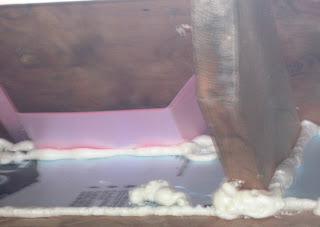
To ensure proper air flow, Randy placed a proper vent in the space above that extended from the soffit area to above the insulation in the attic. As shown in the series of photos below, he then cut pieces of XPS foam insulation and used spray foam to hold everything in place and force any air to move through the vent into the attic space (rather than around it).

Test fitting the proper vent and rigid foam insulation.
Here is how the test fit looks from inside (before proper vent)

First step with spray foam behind foam board insulation and all cracks.
Everything spray foamed tight and sealed so air can only go into the attic space via the proper vent
A side view of the work, note this will be covered by the soffit so it is all hidden
Here's how it looks when finished

So that completes the air sealing the soffits. Next Randy added insulation in the eaves.


Randy was finished at this point, so I added some foam board insulation on top of the batts to make an insulated space that should make the bedrooms warmer and less drafty. 

Eave area with the foam board insulation and spray foam.
When budget permits, I may go back and insulate the floor with foam board insulation also. For now, I am calling it quits.

The final step was to add an additional 15" of blown in loose fill insulation to the attic area.

Attic showing additional blown-in loose fill.


I am looking forward to having Erik North back next week to evaluate our home and get the rebate into the State.


More than that, I anticipate we will be much more comfortable this winter while using less oil to heat our home.

Cheers,

Mark

Saturday, July 24, 2010

Efficiency Maine Home Energy Savings Program-- EXTENDED!


Efficiency Maine (http://www.efficiencymaine.com/at-home/hesp_program) has been offering an additional incentive ($1000) to get homeowners to improve the efficiency of their homes (air sealing, insulation, and space or water heating improvements).

What is it? If you follow the program and make improvements to achieve either 

1) at least 25% increase in efficiency (annual thermal energy savings) you receive 30% of the total project cost up to $1500*.
2) more than 50% increase in efficiency (annual thermal energy savings) you receive 50% of the total project cost up to $3,000*.

*Both of these are increased by $1000 if you sign up by 8/31/10, then complete the energy audit and the Incentive Application Form (http://www.efficiencymaine.com/docs/hespincentiveapplicationform.pdf) must be received by September 30, 2010, and complete all work and the Completion Form (http://www.efficiencymaine.com/docs/hespprojectcompletionform.pdf) submitted by December 31, 2010.

Step 1. You get your house audited ($400-$500). This typically entails inspection of insulation, air leakage (blower door test), mechanical heating/cooling systems evaluation. Sometimes auditors also use infrared imaging to evaluate your home. The auditor will produce a report  to guide you in determining the cost/benefit of  energy improvements you may wish to make by calculating projected savings and payback information. Note this step must be completed by a Participating Energy Advisor  (listed on the Efficiency Maine website).

Step 2. Work with a contractor of your choice to do the work. Remember that you want to get to at least 25% improvement to meet the minimum rebate criteria.

Step 3. Auditor returns and inspects the work and completes the form documenting the improved efficiency in your home.

Bottom line: if you make improvements to your home that result in a 25% increase in the efficiency of your home you can get up to $2500 back from efficiency Maine.

I have done a lot of weatherizing and made improvements to minimize waste. I was skeptical that I could make improvements for less than $5000 that would result in 25% improvement in efficiency.  So, I contacted Mary at Warm Tech (207-883-9722) for a Home Energy Analysis. This is not a home inspection, but a visit that includes a walk through of your home to give you an idea of what the audit will likely find. I had a coupon from the Sunrise Guide (http://www.thesunriseguide.com/) for a free Home Energy Analysis. Mary and Roland spent nearly an hour with us and pointed out a lot I could do. They are GREAT!

As a result of their visit, I contacted Erik North (Free Energy Maine, LLC; 207-329-7219;
www.freeenergymaine.com) to schedule an audit. Not surprisingly, he is quite busy doing audits. I scheduled our audit for August 6. 

I will post another blog about our audit and the results.

Cheers,

Mark